November 2, 2026
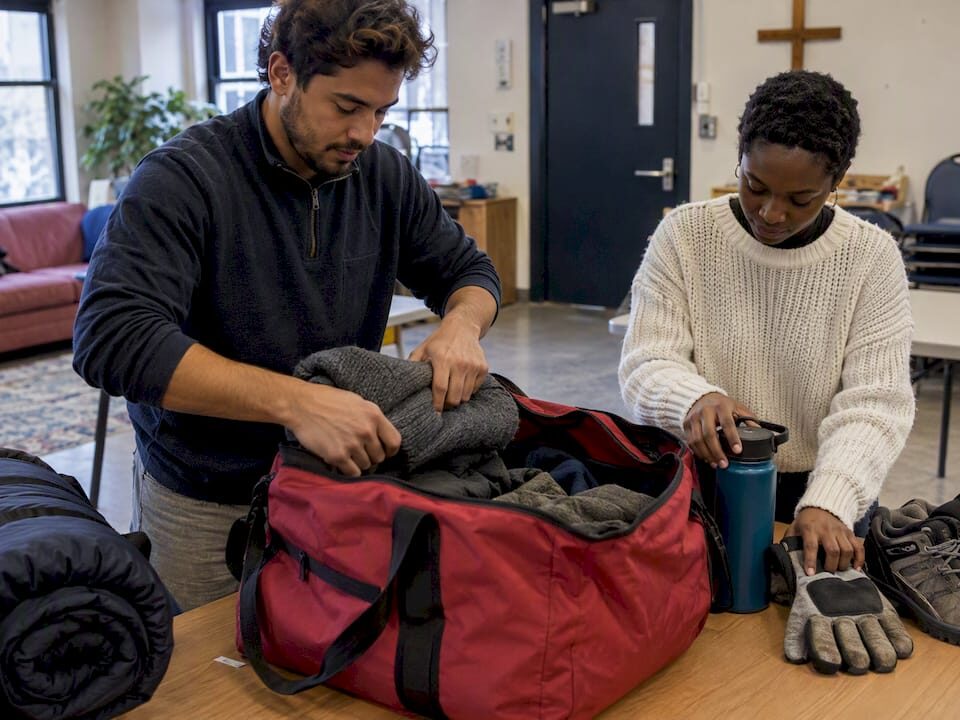
A practical mission trip packing list for teens and adults: essentials, winter layers, work gear and NYC specifics, plus what to ask your coordinator first.

We also accept other Non-Traditional Gifts.
Click here to learn more
We also accept other Non-Traditional Gifts.
Click here to learn more
We also accept other Non-Traditional Gifts.
Click here to learn more
We also accept other Non-Traditional Gifts.
Click here to learn more
We also accept other Non-Traditional Gifts. Click here to learn more
We also accept other Non-Traditional Gifts. Click here to learn more
Mission Trip Packing List for Urban and Winter Trips
November 2, 2026New York School of Urban Ministry
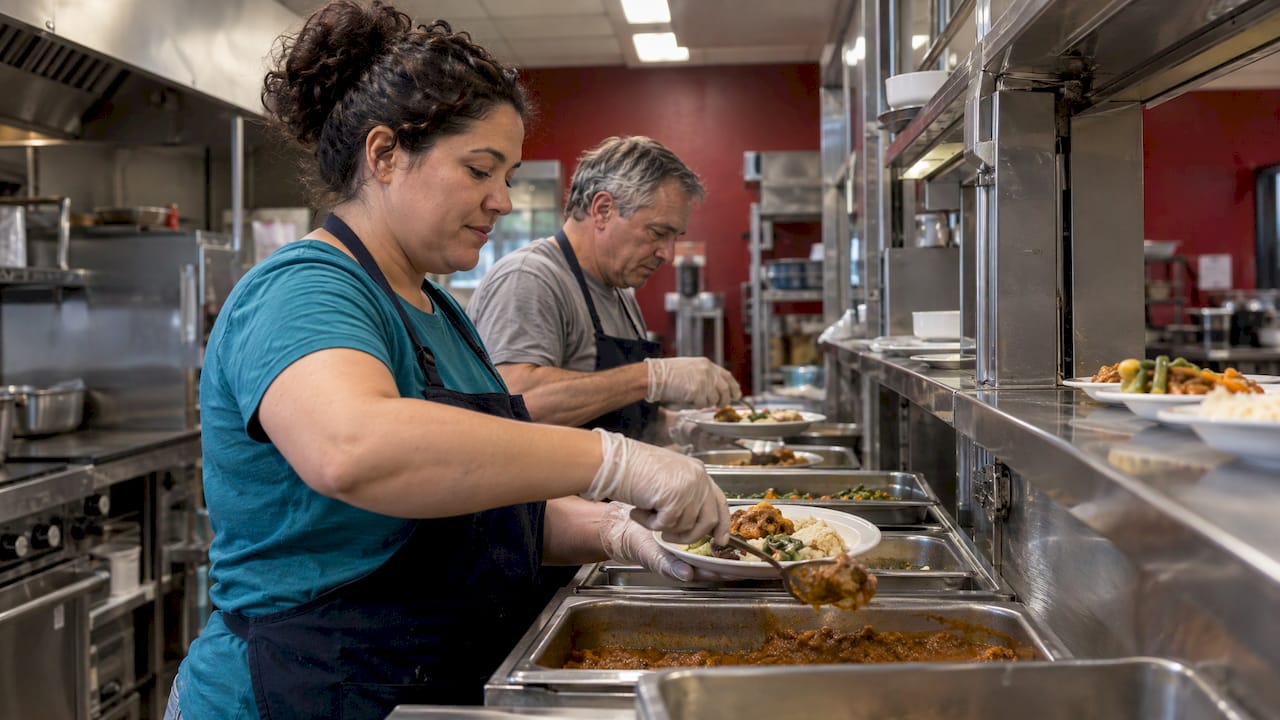
A domestic mission trip is a short period of organized service and ministry inside the United States, usually a weekend to a week, where a church, youth group, college ministry or group of adult volunteers works alongside local believers to meet real needs. You don’t need a passport. You need a willing team, a trustworthy local partner, honest preparation and a plan to keep serving after you get home. This guide walks through what the work looks like, who can go, how to prepare safely, and what a trip in New York City looks like with us at NYSUM.
The word “mission” often calls to mind a flight overseas. Yet many of the people your group can serve live a few hours’ drive away, or one state over. Domestic trips take place in cities, rural towns, disaster zones and neighborhoods where the church is already at work and could use extra hands.
The work varies widely. Common settings include:
What ties these together is that the work grows out of a need your host already knows about. A trip that begins with the host’s priorities tends to leave something lasting. A trip that begins with the group’s agenda often leaves a mess for someone else to clean up.
There are good reasons many churches choose to serve within the U.S., especially for a first trip.
Lower barriers. There are no visas, no vaccinations to schedule and no language barrier in most settings. Travel can be a van ride, a train or a short flight, so more people can say yes.
Shorter lead time. A weekend or three-day trip fits around school, work and church calendars. Groups with limited vacation can still serve meaningfully.
Cross-cultural learning without a plane ticket. A large city puts you beside neighbors from many backgrounds, languages and life situations. That stretches a team in ways that surprise people who expected a “safe” trip.
A bridge to your own community. Students who serve in another city often come home asking who needs help on their own street. That is the best result a trip can have.
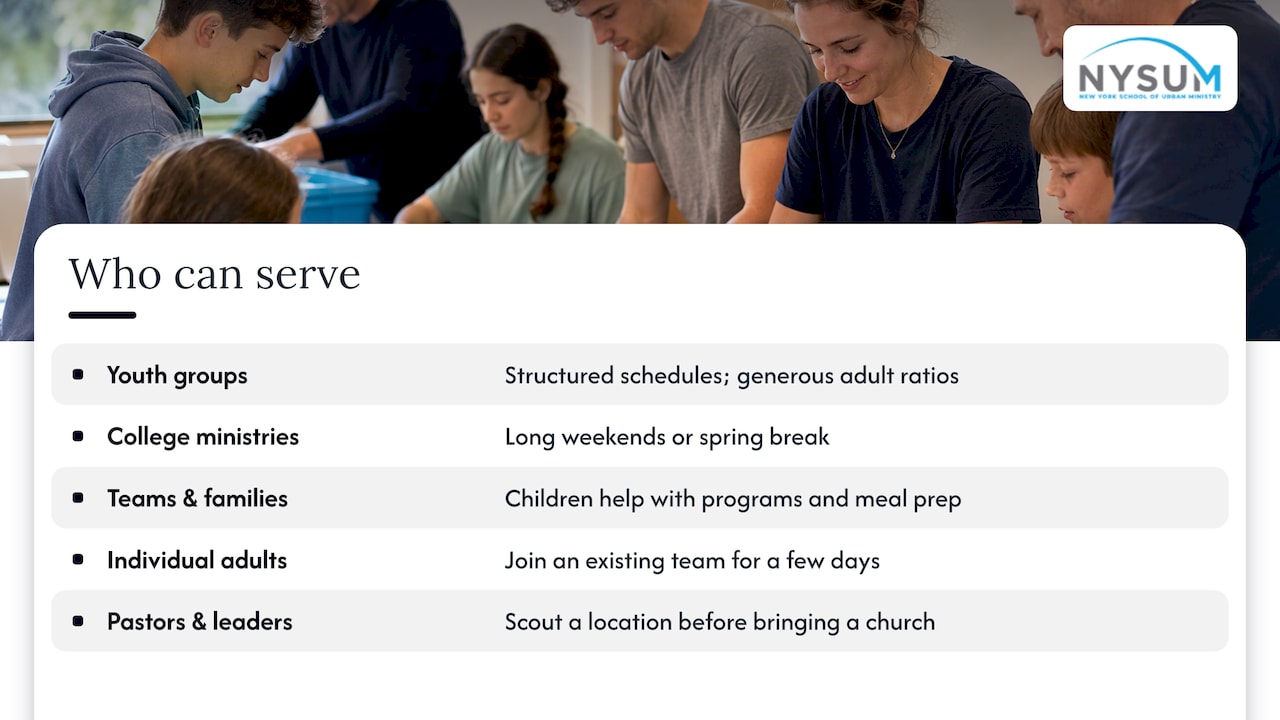
Youth groups. Middle and high school students can serve well when the schedule is structured, the tasks suit their age and the adult-to-student ratio is generous. Youth pastors often choose domestic trips because a parent can reach their student by phone and pick them up in an emergency.
College ministries. Campus groups often fit a trip into a long weekend or spring break. College students tend to bring energy and flexibility, and many can handle longer days and more demanding outreach.
Church teams and families. Mixed-age teams can serve together when the assignments are chosen with care. Children can help with kids’ programs and meal prep, while adults take on street outreach or longer shifts.
Individual adults. Not every volunteer belongs to a group. Some join an existing team to serve for a few days, which can be a good way to test whether a longer commitment is right.
Pastors and leaders. Many pastors go to scout a location before bringing their congregation. Seeing the ministry firsthand makes it far easier to cast a vision and answer parents’ questions.
Most domestic trips run from a weekend to a week. Short formats work well for first-time teams and for groups that can’t be away long. Longer ones allow deeper relationships with a host church and a wider range of ministry.
A typical day on a well-run urban trip follows a rhythm like this:
The debrief matters as much as the outreach. It is where teenagers and adults put words to what moved them, and where leaders can gently correct misunderstandings.
Costs depend on distance, length, lodging and meals. A drive-in trip to a nearby city costs far less than one that needs flights. When you compare options, ask every organizer the same questions: What is the per-person price? Does it include lodging, meals, ministry supplies and local transportation? Which costs are added later?
We publish our NYC prices so groups can plan from the start. These are the per-person amounts on our reservations page, as read from our site in September 2026. Confirm current amounts there before you budget.
| Package | Price per person |
|---|---|
| Discover NYSUM | $50–$52 |
| Weekend Package | $241–$251 |
| 3-Day Trip | $341–$355 |
| 5 Day Trip | $544–$566 |
| City Fest | $382–$398 |
| Back to School, Extreme Makeover, Operation Drumstick, Christmas Compassion Weekend | $261–$272 each |
| Christmas Compassion | $554–$577 |
| Single Outreach + Transportation | $28–$29 |
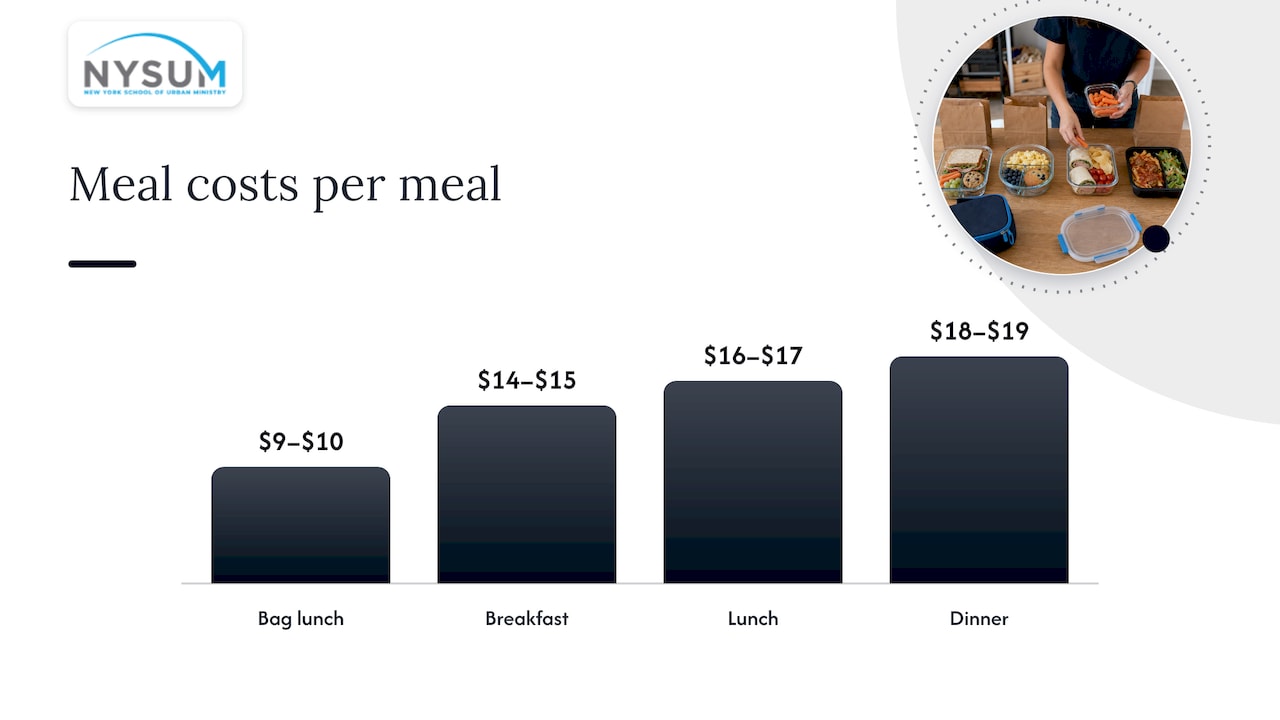
Groups that want to arrange travel around the city can add NYSUM van and subway transport: $37–$38 per person for a weekend, $47–$49 for three days, or $58–$60 for a week on the van. Meals can be added on our additional services page: breakfast at $14–$15, lunch at $16–$17, bag lunch at $9–$10 and dinner at $18–$19 per meal.
The biggest variable for most teams is how they cover the cost. Many groups ask each participant to raise part of their share through support letters, church fundraisers or a congregational offering. Decide early, tell families the full cost up front and set a date for final payment well before departure.
The best trips are won or lost before anyone boards the van. Here is a sequence that works.
The Presbyterian Church (USA) advises that a strong short-term trip involves on-the-ground leaders who help plan, lead and interpret the experience, and that trip objectives are developed together with them. The point holds for any denomination: your host knows the neighborhood, the people and the need. Let them tell you what would help, then shape your plan around it.
The same PCUSA guidance recommends orientation through three or more face-to-face meetings, supplemented by readings and videos. Topics include personal reflection, the culture and context of the place and partner, cultural humility, group roles and trip expectations. Use those meetings to pray together, assign jobs and talk through hard questions, such as how to treat someone who is hungry or in crisis with dignity.
Teams that invest in how their members lead, communicate and work together tend to travel better. If you want to build those skills before departure, look into leadership development for teams and adapt the ideas to your trip captains.
If students are traveling, safety policy is not optional. Church bodies publish clear examples you can borrow:
Your own denomination or church insurer may set different rules. Ask your pastor or church office for your policy before you plan anything, and follow whichever standard is stricter.
The Indianapolis policy requires short-term trip or supplemental insurance, often available as a rider on a church’s existing policy, to be secured at least a month before travel. It also recommends that every traveler carry a copy of their personal health insurance card. Call your church’s insurance agent early and gather signed medical release forms, allergy information and emergency contacts for every participant.
A trip should not end at the parking lot. Schedule a debrief meeting within two weeks, invite students to share in a worship service, and decide on one way your church will keep serving, whether that is a monthly meal ministry at home, ongoing prayer for your host church or a return trip next year.
When you compare organizers, look at the quality of the relationships, not just the destination. Questions worth asking:
New York City is one of the most concentrated mission fields in the country. Millions of people live within a few miles of each other, speaking hundreds of languages, and the needs are immediate: homelessness, hunger, isolation, children who need a safe place to be loved. Churches there are doing steady ministry, and teams from across the country can join them.
At NYSUM, we train and deploy individuals and groups for short-term mission trips across the five boroughs. We partner with local churches and communities, and our work reaches more than 5,000 trainees each year and includes serving more than 16,500 meals through outreach. Trip activities can include food outreach, street evangelism, prayer walks, children’s programs, soup kitchen volunteering, compassion outreach and cross-cultural ministry. We offer lodging and meal plans for teams, individuals and youth groups, so a church can plan one stay instead of piecing together several.
If your group is in Texas, Florida, Ohio, Georgia, the Carolinas, Tennessee, Michigan or anywhere else, a weekend in NYC is often more reachable than people expect. Many teams travel by van, bus, train or a short flight and spend a long weekend in ministry. You can read more about urban mission trips, church mission trips and our homeless outreach in NYC.
We have watched thousands of people arrive in New York City nervous and leave changed. The pattern is consistent: when a team prepares well, serves alongside local believers and listens before it speaks, God uses a few days to do far more than the schedule promised.
That is why we do not treat a mission trip as a one-off event. Our approach is immersive training paired with real outreach, so that your group learns how to serve and then does it, with local churches and communities who are there long after you leave. A trip is a beginning. We want it to shape how your students, your members and your church love their neighbors for years to come.
If you are weighing a domestic trip, we encourage you to start with the people you hope to serve, not the itinerary. Ask what they need. Prepare your team with humility. Then go, and put your faith into action.
Pastor Peter M. DeArruda NYSUM President
We would love to host your church, youth group or college ministry. Our packages cover ministry, training and outreach, and we can add lodging, meals and transport so your leaders spend less time on logistics and more time on people.
We publish prices for each package, so you can budget with your team before you commit.
See every option and book on our reservations page, or browse our ministry packages. If you are still planning, our mission trip planning guide for churches walks through the steps in more detail.
It is any organized trip of service and ministry within the United States, usually lasting from a weekend to about a week. Typical work includes food outreach, children’s programs, home repair, homeless outreach and prayer. The key feature is working with a local partner who knows the needs.
They can be when leaders plan carefully. Use background checks for adult volunteers, keep chaperone ratios high, carry insurance and medical forms, and follow your church or denomination’s policy. Sample ratios in published church policies are one adult for every five youth under 14 and one for every seven youth ages 15 to 18.
It depends on distance, length and what is included. Our NYC packages are published per person, starting at $241–$251 for a weekend and $544–$566 for five days, with meals and transportation available as add-ons. Always confirm current amounts on our reservations page.
Both can take part. Groups often book full packages together, and individual adults who want hands-on ministry can serve through our offerings as well. Visit our reservations page to see what fits.
Most first-time teams do well with a weekend or three days. That is long enough to serve and debrief, and short enough for busy families and students. If the trip goes well, a longer one the next year lets you go deeper.
Tel: 718.204.6471 | Email: info@nysum.org
This website uses cookies
We use cookies to personalise content and ads, to provide social media features and to analyse our traffic. We also share information about your use of our site with our social media, advertising and analytics partners who may combine it with other information that you’ve provided to them or that they’ve collected from your use of their services.
Cookies are small text files that can be used by websites to make a user's experience more efficient.
The law states that we can store cookies on your device if they are strictly necessary for the operation of this site. For all other types of cookies we need your permission. This means that cookies which are categorized as necessary, are processed based on GDPR Art. 6 (1) (f). All other cookies, meaning those from the categories preferences and marketing, are processed based on GDPR Art. 6 (1) (a) GDPR.
This site uses different types of cookies. Some cookies are placed by third party services that appear on our pages.
You can at any time change or withdraw your consent from the Cookie Declaration on our website.
Learn more about who we are, how you can contact us and how we process personal data in our Privacy Policy.
Please state your consent ID and date when you contact us regarding your consent.